For Day 2 in 2025, the organisers made a sensible call: we started at Inverness and paddled back to Fort Augustus because the wind had pivoted 180 degrees from the day before. Another early start: leaving Fort Augustus at 5:30am to reach Inverness for a 7:30 start. Great Glen does not encourage lie-ins.
Before the start I chatted with Mike Barron, fresh off winning his age group at the 11 Cities the week before, and paddling Great Glen at astonishing pace. He gave me a visual anchor that stuck: a NIKE swish—get the paddle in early and deep, then pull up using the core. I used that phrase as my metronome for the next 47km.
The first 10km flew by—flat canal, low bridges to keep you honest—and then, after a short portage, came the moment you feel in your chest: you enter Loch Ness.
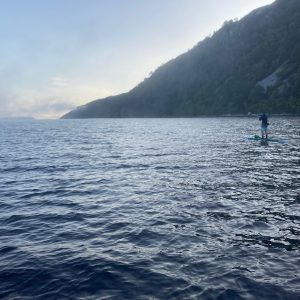 Loch Ness gives you highs… then takes payment
At first it was intoxicating. We could see Mike Barron ahead as a distant speck—loneliness personified—leading from start to finish without seeing another paddler for hours. Niall chose a route closer to the north shore for shelter and what looked like the shortest line on maps. I would have been tempted by the centre line, but shelter beats aesthetics.
After 15km the wind moved behind us and we were clocking around 10km/h. And my brain, as usual, tried to sabotage me:
“This is great… so easy… a real pleasure!”
Such thoughts can only manifest problems. They did.
Suddenly the wind shifted to an angle and a new kind of wave appeared—close together, buffeting us toward the shore. The shoreline had man-made walls that bounced the waves back at us. Rhythm vanished. It got cold. I started to fear falling in. My feet were numb inside two pairs of waterproof socks stuffed into thermal wellington boots—an ambitious plan to stay warm and dry that, unfortunately, removed all board feel.
I tried to escape the rebound and head out. I fell in. The wellies filled with water. Plan evaporated.
Then Mike Davies came past us so easily on his unlimited SIC Bayonet downwind board. I own the same board and watched with a mixture of admiration and jealousy, because I knew exactly what was happening: the right hull in the right conditions turns chaos into forward motion.
 With 7km to go we heard shouting from shore—Jane and Anne (our respective wives) were nearby. It lifted Niall, who proceeded to sprint the last 6km. I was in full struggle mode: my board barged by swell from behind, left leg cramping, feet carrying kilos of water, morale on the floor. An hour earlier I’d been on top of the world. Such is SUP on Loch Ness.
I could finish, but it felt like Nessie had “nearly beaten me” and that left a strange low when I should have been buzzing.
The last 100 metres offered one more trap: the River Oich enters Loch Ness to create water that looks like it’s boiling. With a crowd watching, I had the classic decision: stay standing or go to knees. I went to knees. I couldn’t face another dunking.
Back on land I sat and tried to clear my head. Coke and egg sandwiches took the edge off the disappointment. But a key win revealed itself: I’d got through without the evil cramp. Salt water and simple choices had beaten fancy glucose-laden drinks, which became sickly fast and didn’t quench thirst at all.
The evening do was a reminder of why this event works. Paddlers are grounded people. I suspect anyone with a big ego stops paddling once wind and water have chewed them up a few times. The organisers and support crew do a job that is, frankly, a logistical nightmare. And the field is full of quiet heroics—people paddling inflatables for seven hours plus per day, taking on something enormous because they want to find out who they are when it gets difficult. Hats off to them.
The Great Glen is iconic: setting, format, unpredictability, and a community that feels like it’s in it together. It becomes part of your psyche long after you finish—whether you do one day or two. If you’re tempted, don’t wait until you feel “ready.” Train for efficiency, practise handling rougher water, take the team format if it’s your first go, and trust that the event will meet you where you are… and then stretch you a bit further.