In 2025 I entered Great Glen in the two-day team category with my SUP compatriot Niall Colquhoun, a Great Glen Paddle Challenge veteran. Looking back, being paired with someone experienced gave me a little too much confidence. I convinced myself I could draft my way to any finish line regardless of distance. That’s a lovely theory. The Great Glen has a way of correcting theory.
 Training honesty (and what I’d do differently)
The 2025 summer had been a varied programme of races—short sprints, 18km downwinds, beach races—so my mind only started focusing properly on Great Glen about two weeks out. Realistically, that meant one week of purposeful training: three 15km paddles and some zone-2 “economy stroke” focus. Useful, but not enough to really understand what was coming. Even after quizzing a stack of previous competitors, I hadn’t grasped how the event would feel on the day. That lack of true understanding absolutely limited my preparation.
If I did it again with serious intent, I’d plan three months of structured base work: long, even paddles at target pace, plus technique under fatigue. Great Glen is less about peak power and more about how long you can hold form.
(Book tie-in, naturally): this is exactly why I bang on about efficiency. It isn’t “paddling pretty.” It’s energy management, and it decides whether you finish strong or finish haunted.
The one-day competitors started in the dark—yes, really—before most normal humans have formed thoughts. Two-day teams had slightly later slots, but it’s still early enough that your body is awake only because you forced it to be.
The first 10km along the canal are fast and deceptively pleasant. Drafting worked well, we found a steady pace, and I had to fight the little voice that whispered: “This is easy.” The only correct response is: “Don’t get cocky, it’s only 10km.”
 Transitions: the hidden race
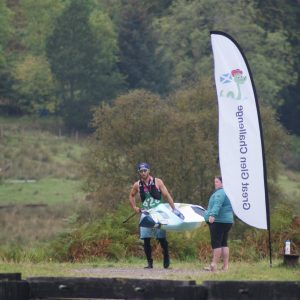
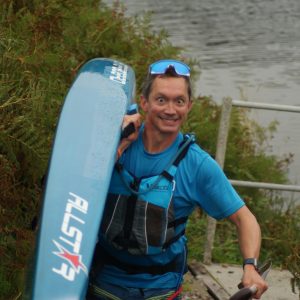
The portage before Loch Lochy is long. We’d overtaken plenty of paddlers on the water—only to watch some stroll past us on the carry. They had carrying belts. We had… optimism, and a tendency to drink and joke on land like minutes didn’t matter. This is the first Great Glen truth: time on land becomes distance on water frighteningly quickly.
Loch Lochy began flat calm, framed by mountains, and for a moment it felt like the “poster version” of the race: beautiful, controlled, cinematic. There were dozens of paddlers ahead of us, each in a private battle with mind and body. I wanted to chase everyone down. Niall knew better and set a conservative pace.
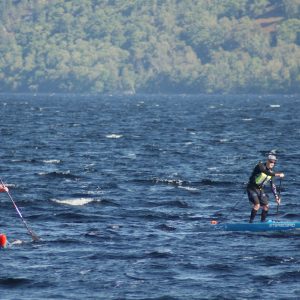
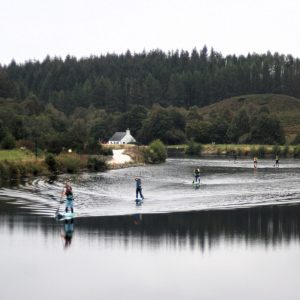
Eight kilometres into Loch Lochy the loch reminded us who was in charge. We’d been promised sea-like conditions and suddenly it obliged: rivulets became small waves, gusts pushed into the 20–25 knot range, and the paddle stopped being sightseeing and started being work. Part of me wanted to go all out because it was fun. Another part feared burning too much too early. We were only 18km in.
 The cramp episode (and the real lesson of Day 1)
At around 27km, coming off Loch Lochy, we hit a short canal stretch before Loch Oich. This is where my day nearly ended.
My entire body became consumed by cramp—lats worst, then fingers/hands, thighs, even feet. It felt like being tasered by special forces. I started using odd paddle angles because certain positions triggered attacks. I slammed electrolyte gels, took salt pills from Niall, and managed to keep paddling. But the mood changed completely: enjoyment and cockiness were replaced by suffering, fear, and a very simple desire to finish.
That’s the point where Great Glen stops being “a long race” and becomes “a long problem.”
I finished Day 1 shocked: tired, yes—but more rattled by the cramp than by the distance. And then came the mental game for Day 2: What if that happens again on Loch Ness with nowhere to hide?
The support and camaraderie at the finish is second to none. People helped me onto dry land. Coke, doughnuts, coffee. You don’t always remember what you said, but you remember the feeling: we look after each other here.
Enter the Great Glen Paddle Challenge in 2026 and get a copy of Andy Burrow’s book for only £10 (instead of £16.99) – a special discount code will be emailed out to you giving you access to buy Andy’s book for only £10 from our parent company Sailingfast Ltd.
If you want a practical way to build an “economy stroke” that holds together late in the day, that’s the Efficiency section of Improving Your Stand Up Paddleboarding—because the Great Glen punishes sloppy mechanics when you’re tired.
Next in the series: Day 2 on Loch Ness—speed highs, rebound-wave lows, and the kit choices that matter when the loch turns strange.